|
Johnsons's Rexall Soda Fountain
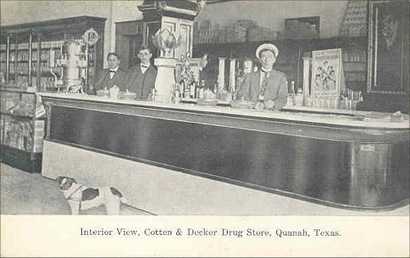
The soda fountain shown here in the drug store on TexasEscapes looks like the very same one that was there in our time when the store was Johnson's Rexall Drug Store. When I was in about the 5th to 7th grade I would do live commercials for Johnson's on my daily radio program on KOLJ.
I remember that one Mother's Day back in the 1950s it was in Johnson's Rexall Drug Store that my two little brothers and I together bought a camera for our mother. Dad took us in there and we all pooled our money to buy that Kodak Brownie camera. She used it until just a few years ago, bringing it with her on two trips to Kenya to visit us, and trips to many other places. It finally got too hard to buy the film for it, and she had to "upgrade" only a few years ago.
|
 |
 |
The QA&P Railway
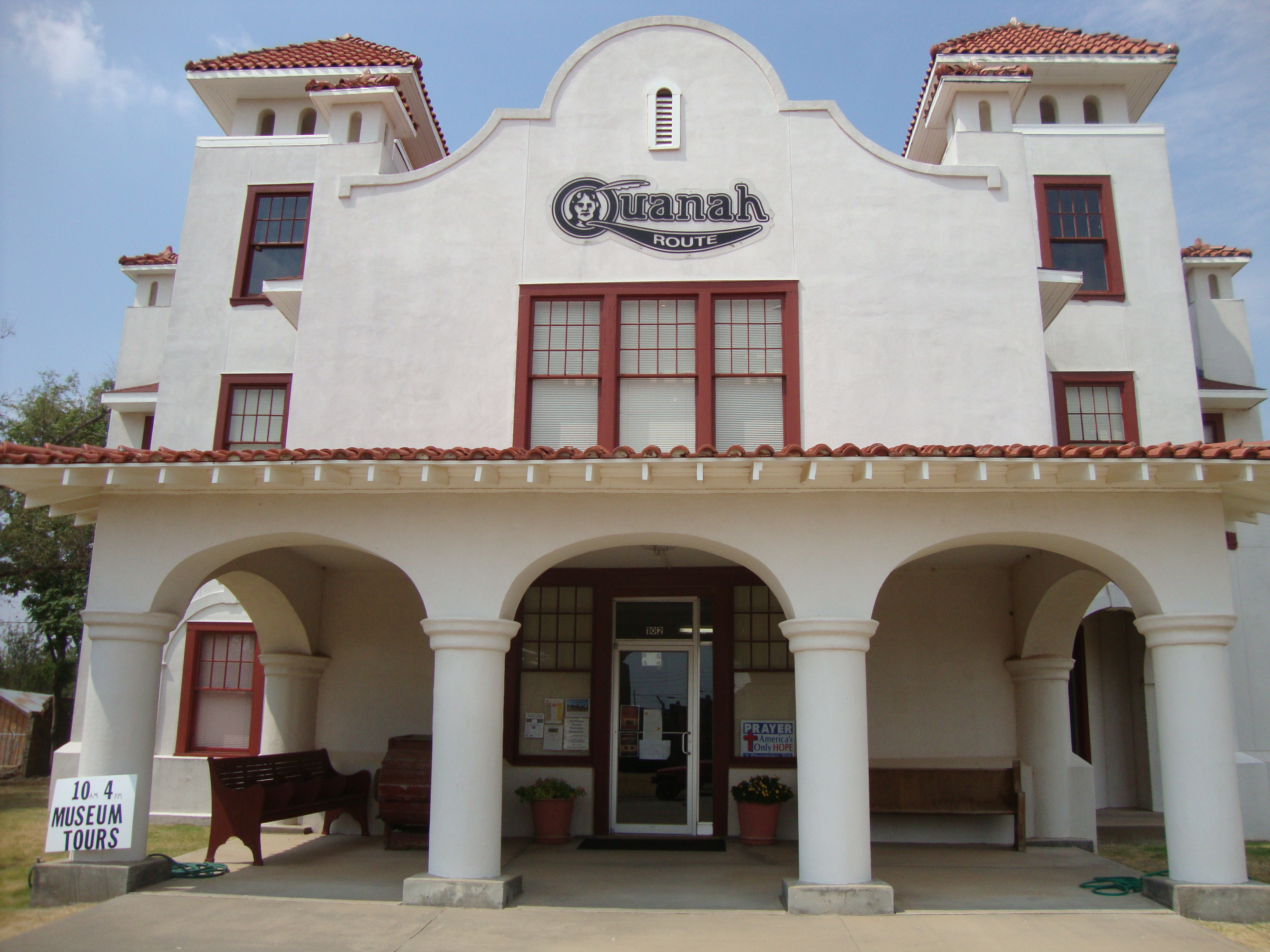
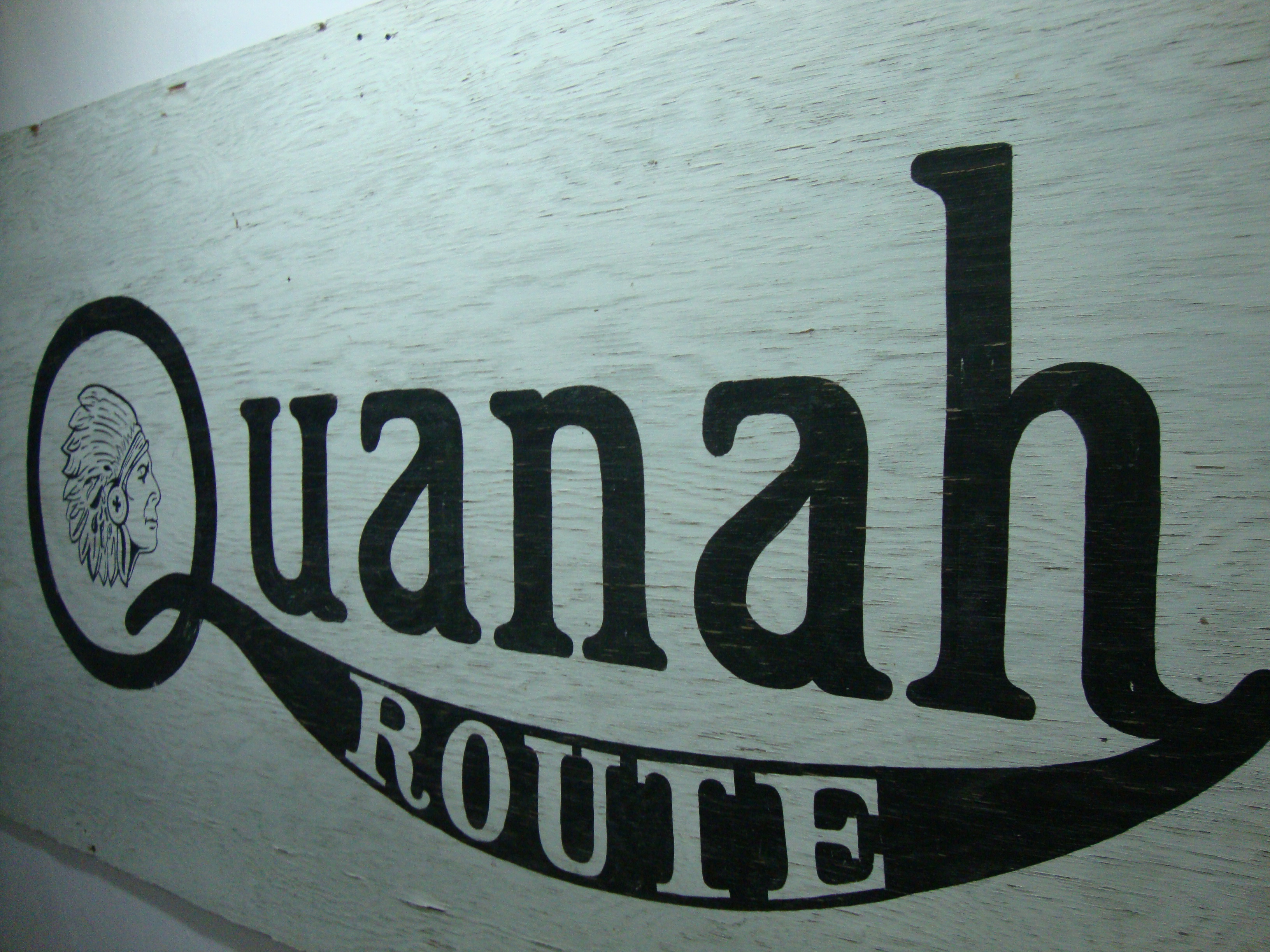
The small picture near the end labeled "Museum" is the old railroad station for the Quanah, Acme and Pacific Railway. This was already a derelict when I was a kid. Passengers had to board at the main freight depot, about 2 blocks away over on Main Street at the RR tracks. QA&P was primarily a freight company by then, and was shortly afterwards absorbed into the Frisco line, before 1963 when I moved to Arkansas.
The QA&P was the first railroad in America in which a founding shareholder was an American Indian. Chief Quanah Parker, for whom the town is named, encouraged investment in the modern technology, considered a bane to the Plains Indians and the iron horse cut through hunting lands of the Native Americans. Chief Quanah was an original partner in the QA&P. Cattle shipping was a large part of the early transport business, and the cattle sale barn still was a big operation when I was living in Quanah.
|
|
|
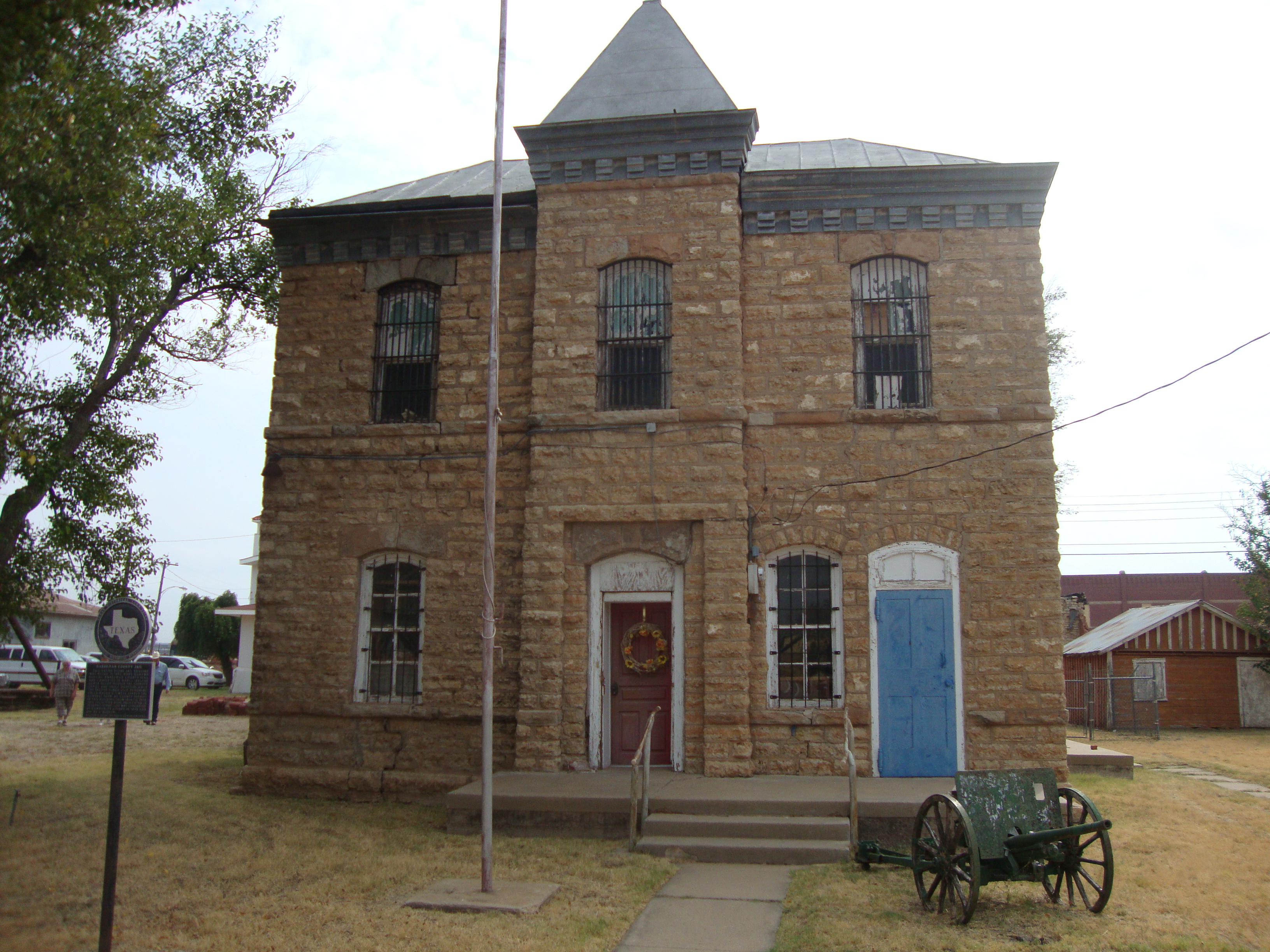
For the Texas Sesquicentennial Celebrations (1958), they remodeled the old depot/station at 101 Mercer Street downtown, about one block west of Main, a block north of the Quanah Hotel. This was the exposition center for the Centennial of Quanah, and later became a permanent museum.
Acme was about 5 miles west of Quanah, on Hwy 287. Sometimes some of us would ride our motor scooters out to Acme. Cushman Eagles were really popular then, and there were a lot of them in Quanah. These filled a real need, as most of us had to work at various jobs and needed to get around town, as well as to school and other legitimate activities. And, remember, the dogs all ran loose in town, and some of them liked to chase the scooters.
|
 |
Winter Work and Play
I remember besides working at KOLJ and the Jenkins Laundry, I delivered the Sunday Oklahoman newspaper, like the Post Office, sun, rain, snow. There were some tough winter days on Quanah streets. I delivered the papers door to door on my Cushman Eagle. I remember in the aftermath of one of the blizzards, the streets were covered with snow and iced over. I was up and out in the freezing wind.
On such occasions, I would hand deliver the paper to the porch so it would not get lost or wet in the snow and ice or rain. I remember stepping up onto a covered porch over on 14th Street near the Crowell Highway. I was just placing the paper outside the screen door, when I heard a growl and turned to see a huge white dog over in the shaded part of the porch, still sitting, but on high alert, looking and sounding agitated.
I sweet-talked and sidled over to the steps and was able to get off the porch safely. I must have secreted a lot of adrenaline. That vivid picture and the sounds and smells of that event have stayed with me through the decades when I remember that morning! After that I was much more alert for loose dogs on the dark porches.
I remember some storms that shut the town down, and we had the run of the streets. We could go out and play in the streets! We could go out and skate and skid our scooters on the ice-covered streets! But we were safe and careful – at least I was.
|
|
|
And here's a confession – some of you can join me in this, I remember being in a group! I remember grabbing on to the back bumpers of a lone car when it would come slowly down the snow-ice covered street by Travis Elementary School (now the Quanah Junior High School) on Cain Street, an old stylish brick street. We would ski along behind the car for a few yards. Were we crazy or what? But it never seemed dangerous in the town where everybody knew everybody and we roamed all over town on foot or bike or scooter.
Goodlett
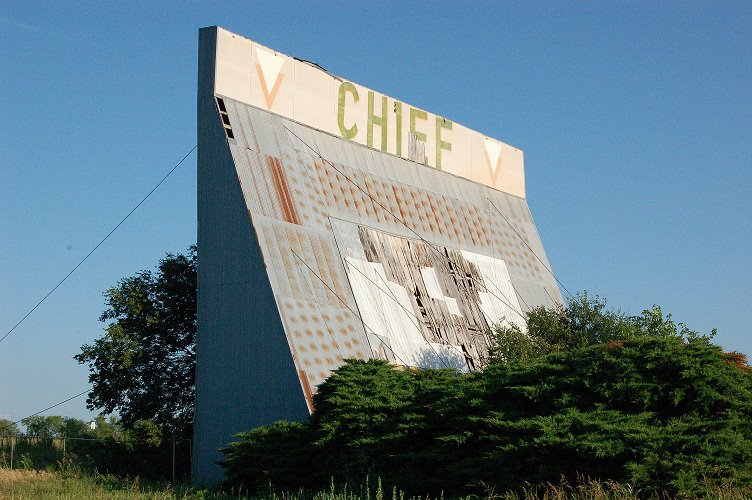
Back to Hwy 287, west of town was the Chief Drive In Theatre. We spent some summer evenings out there, fighting bugs and eating popcorn in the chairs at the concession stand building.
Farther west was the small town of Goodlett, about 9 miles from Quanah, I think. I remember the old Goodlett school gym had become a and we would go on Friday or Saturday nights to skate. Lots of church youth groups had parties at the Goodlett skating rink.
|
|
|
Also in Goodlett, my father had a Mexican restaurant for a while, not long, maybe a year or two. I remember he had a counter and display selling Mexican leather goods, like purses, belts and wallets.
Dad brought back gifts of authentic Mexican leather bullwhips for us. I remember using mine with great excitement and glee. I don't remember many details, but my brother Greg might have some complaints about that in his version of the story.
|
|
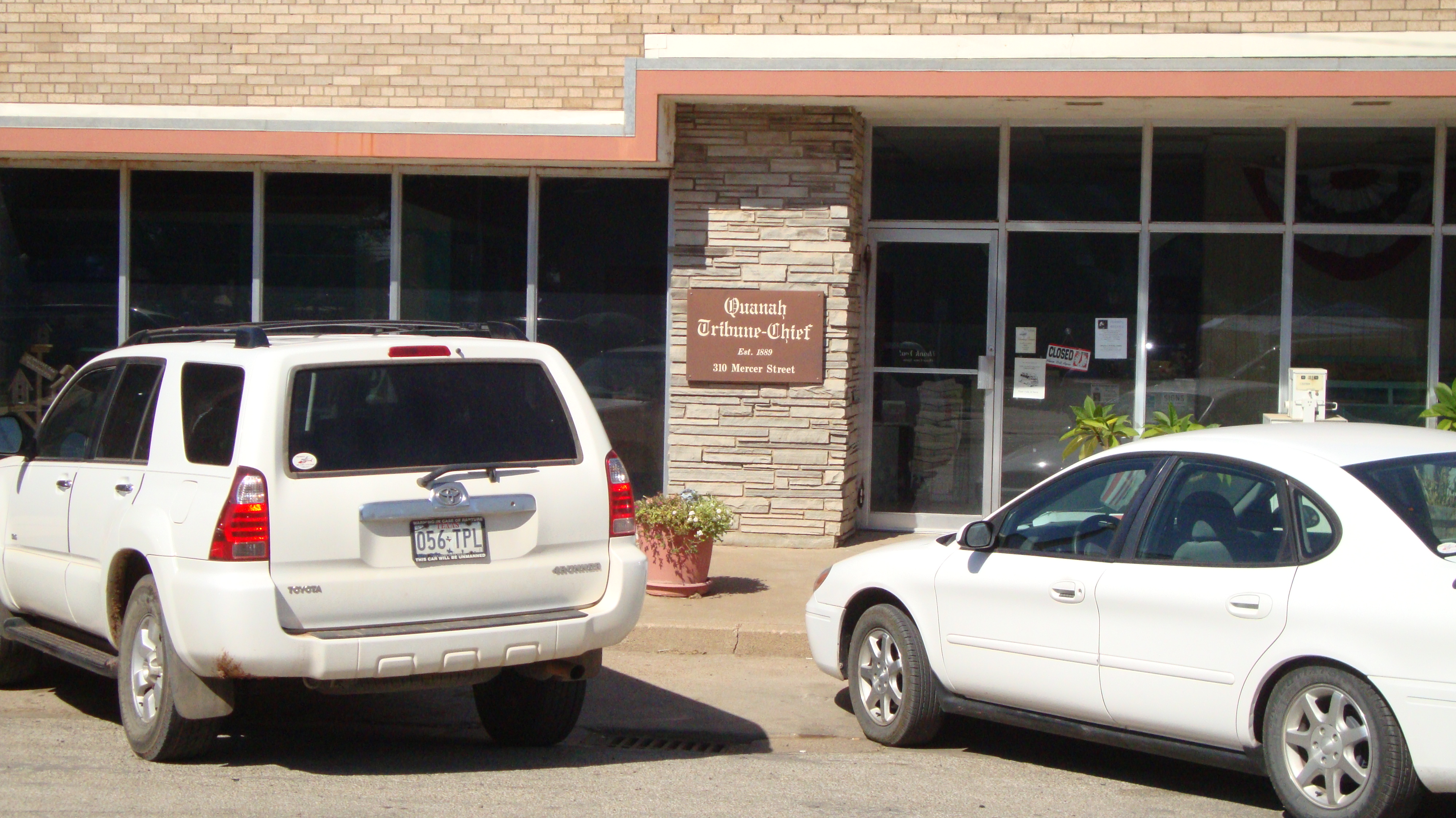
Bob Nelson, who also grew up in Quanah, and was one of the Cushman Eagle group, wrote me in March 2010 to comment on the role of Fred Koch, whose family I know from the Quanah Tribune-Chief newspaper, in the restoration and historical focus in Quanah:
"Fred Koch has been instrumental in preserving some of the buildings downtown and in reviving interest in the town's heritage."
|
|
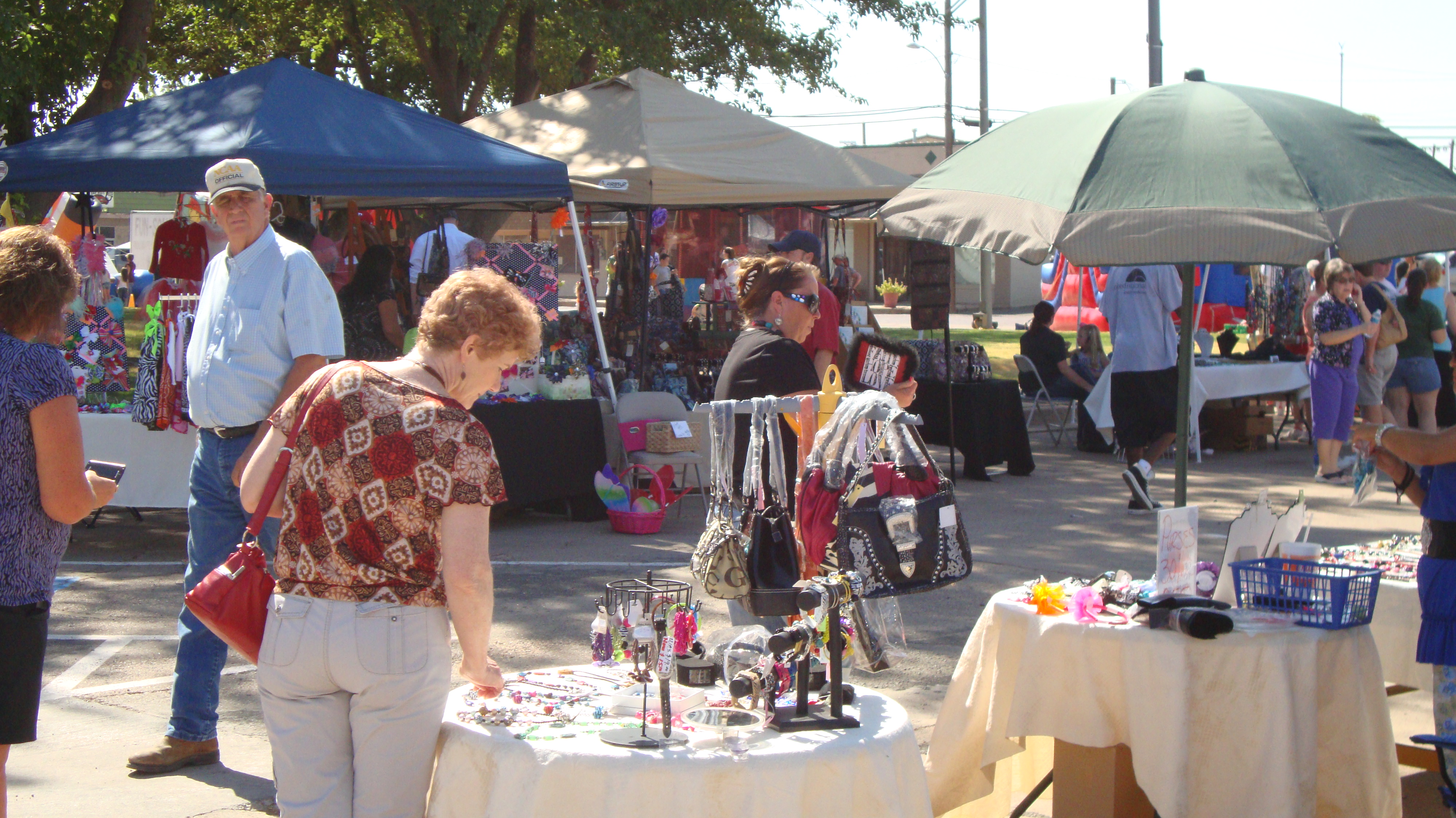
While in Quanah for the 2011 All-School Reunion and Fall Festival, I got a chance to see some of the restored buildings and ongoing projects Fred has been fostering, through the Three Rivers Foundation. This is a cultural heritage and arts foundation with offices in Quanah and Crowell, in Foard County south of Quanah.
|
I had the delightful thrill of meeting an old school mate Carolyn Chapman Wilson, who is the Director of Arts for the Foundation. One ongoing project is restoring many of the old business buildings on Main Street. They have a beautiful ballroom in what used to be the M E Moses Variety (5-10c) Store. School Reunions I have attended there have had their opening receptions and their closing banquets in the ballroom. The Foundation has many cultural projects going on several levels.
Carolyn and her staff are cataloguing a donated collection of 60,000 classic vinyl LP record albums, now in the climate-controlled storage basement of the Foundation's ballroom. Oh, and Carolyn showed us the beautiful and functional bar they bought from the set of the old TV series "Gunsmoke"! I was so excited with everything I forgot to take a picture of the bar and the beautiful ballroom and main salon! This was remedied when we returned for the 2013 reunion.
|

|
Steve's Boot Shop
One of the places I remember in downtown was Mr Podrovitz' boot shop on the east side of Main Street. It was called Steve's Boot And Shoe Repair. I was always fond of Mr Podrovitz. We always took our shoes to him for repair. I loved the smell of leather in the shop. He would always talk to me when I would go in with my father.
Mr Podrovitz' son Steve says his father first worked as a boot maker in a shop called the Texan Boot Shop. It was owned by Ted Truelove and Mr Podrovitz worked for him. Steve is one of the people on the Quanah discussion group and he and I were visiting in February 2014. He told me more details about his father. Steve said his father was from Yugoslavia and his original name was Stephan. He went by Steve. I had somewhat vague recollections, but recall his accent. Steve says that at the outbreak of WWI his father was put to work making shoes for the German soldiers.
|
Stephan learned other languages in the concentraton camp where he was placed, and spoke 17 languages. He learned English when he came to this country. Stephan's funeral was conducted by a Catholic priest who was in the camps with him. On my visit in September 2013, I saw a pair of boots made by Mr Podrovitz, now on display in the Quanah Museum. Mr Podrovitz is a fixture in my childhood memories.
Hendrix Boot Shop
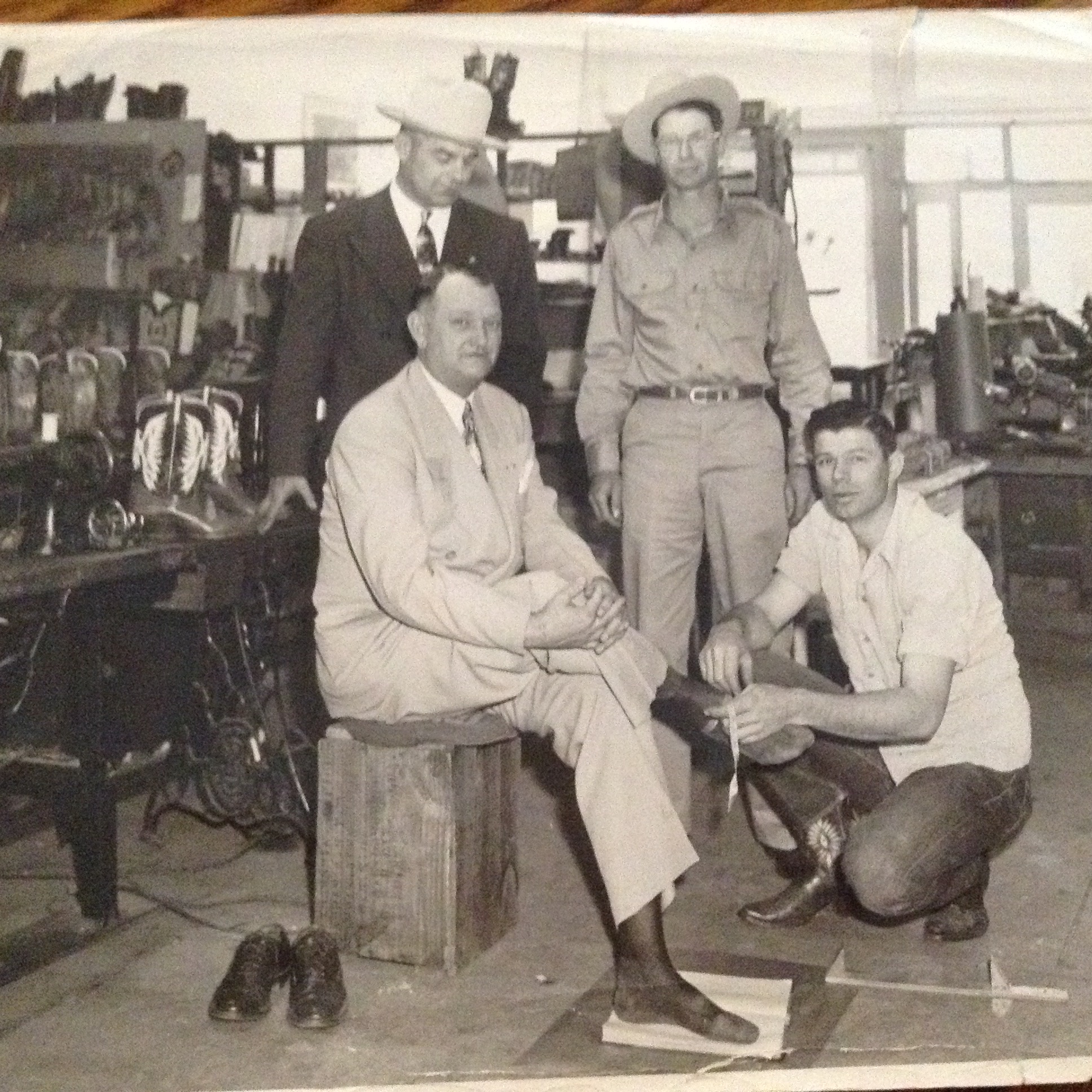
Earlier there had been another boot shop, owned by Theo Hendrix. Theo was a friend of my father. He was a renowned boot maker, and his son Keith says customers came from North Texas and Oklahoma to have Theo make their boots. Keith sent me a photo of his father and friends in his shop about 1952. Mr. Hendrix's shop burned down about 1951 or 1952 in a fire that destroyed or damaged several other stores.
|
Cotton
Hardeman County was a big ranching area. Cotton had also been big there when I was very small. I remember for the first few years in Quanah, we lived about a mile south of the city limits on the Crowell Highway, now Texas Highway 6. The family just north of were an old couple named Jenkins, too, but they were not kin to us. Their son Hayden Jenkins was the veterinarian. I remember walking across the huge field to visit them. Mrs Jenkins would give me cookies!
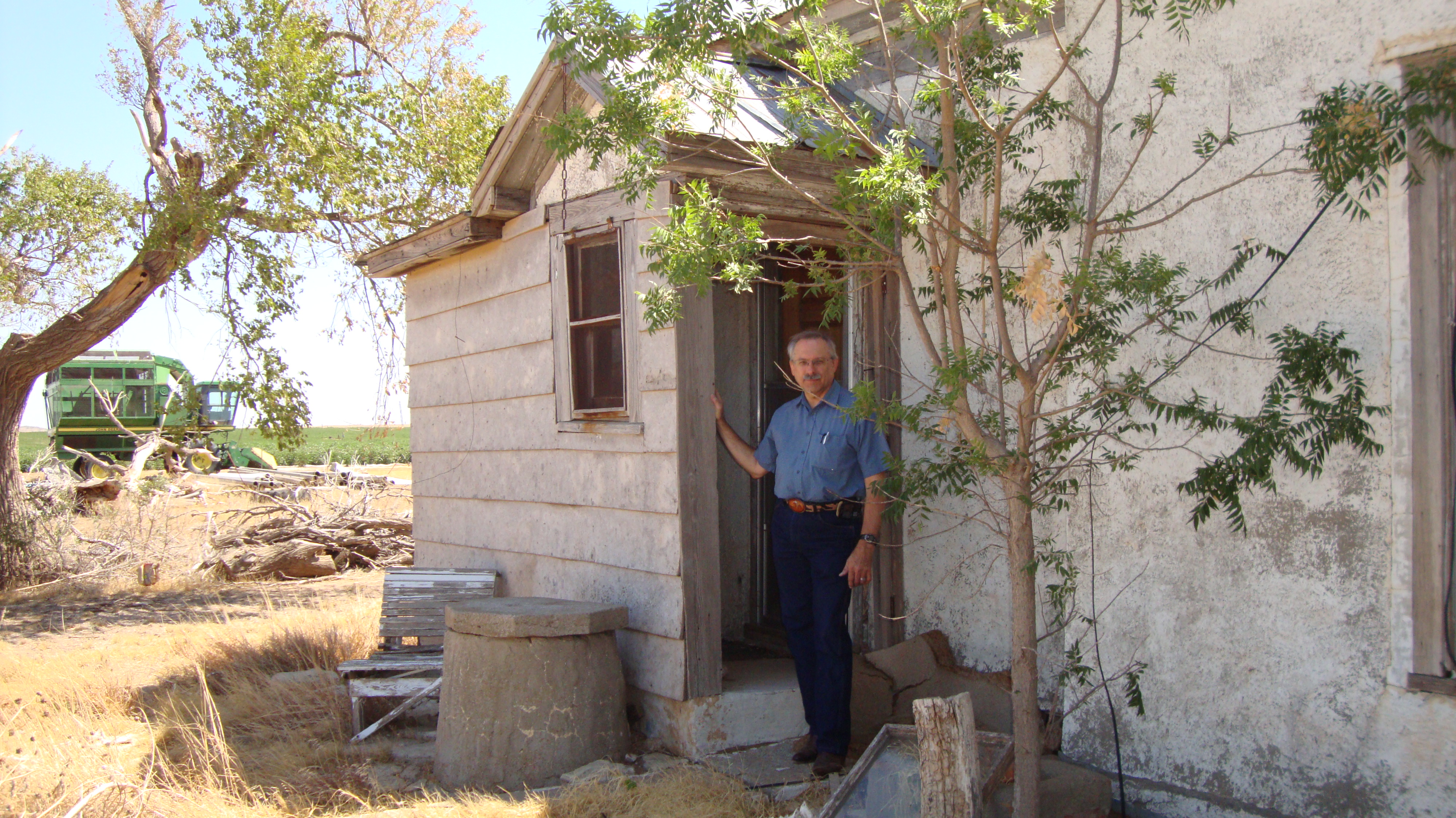
We rented the house on a cotton farm, while the owner, Hamp Stepp ("Old Man Stepp"), continued to raise cotton. I used to talk with Hamp's son Alvie when he was out there to supervise the cotton picking. I remember I was quite young at the time. I could not have been over 6, since we moved from the farm into town before my 7th birthday.
|
I would stand out in the edge of the field past the east end of our house talking to Mr Alvie about the crop and the cotton picking operation, while the pickers were working. He told me about the plant, the cotton, how the cotton forms in the bolls and then is picked. I always enjoyed learning how things worked, how things grew, how crops were managed and harvested.
Alvie had a daughter about a year younger than me named Mattie. In September 2011, on a visit to Quanah for the All-School Reunion, I met Alvie's son Malcolm.
|
My wife and I went out to see the farm, and found the house was still standing, as I remembered it. Malcolm, also in town for the reunion, drove up while we were there and we had a good long visit. They are still farming the place, and we saw a cotton picker in the edge of the field just past the house.
|
Highway 287
We lived on this cotton farm through my first grade of school, then moved into town, to 909 West 11th Street, on the west end of town. Cotton farming gradually diminished over the years. Wheat was the other major crop I recall.
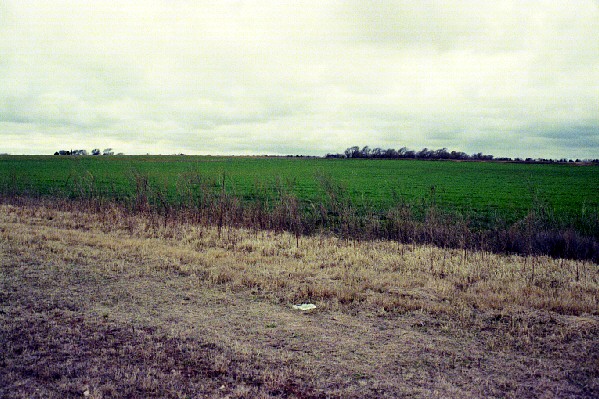
Winter wheat was and still is an important crop. Driving through the area in recent years, I still see wheat growing, but less land than I remember seems to be under wheat cultivation.
|
|
Of course, with the ranching in the area, hay fields were a beautiful contribution to our flat and featureless land area.
Eleventh Street of Quanah was the cross-country highway US 287.
US Highway 287 was the major north-south route from Port Arthur, Texas to Choteau, Montana. It was going basically east-west as it went through our part of the country after coming northwest out of Fort Worth.
|
From Quanah, 287 heads on out to Amarillo before angling up to the northwest. This highway is still heavily traveled with commercial traffic. Since our time there, Quanah has built up its tourist trade around its colorful history. Downtown has been refurbushed, and some of the old buildings gradually restored, due largely to a grant from the while others have been razed. There are a lot of empty lots now, where there were businesses or homes in the old days. The population of Quanah has continued to diminish and there are many vacant and derelict houses.
|
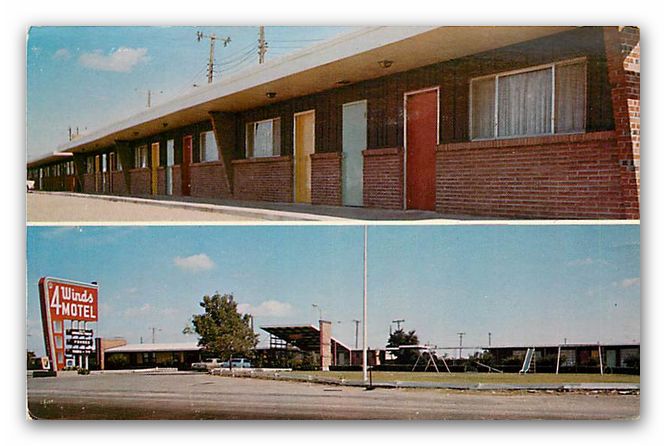
In February 2014 I learned more about the Motels and their connections to Quanah families. On our Quanah discussion group in Facebook, I met another former Quanah resident, Patti Murphy Obannon, who tells me that members of her Murphy family owned both the 287 and the Four Winds motels. I learned Patti has written a book about her Murphy family, and she shared a few tidbits.
I had an uncle who was Chief of Police and my dad fixed TVs for everyone in town for many years. He worked first at Whites Auto until it burned and then moved his business to Becknells.
My dad was Rayford Murphy. His dad worked for the railroad for many years and died just a few days after he retired in 1937. My Uncle Joe Murphy was Chief of Police all the time I was in high school. I could do nothing that my dad didn't know before I got home. Uncle Joe and his wife also ran the 287 Motel for several years and then the Four Winds Motel (now Quanah Parker Inn) [emphasis mine].
My memories that fit with these details. I remember being given a tour with my father of the Four Winds when it was still under construction. In a discussion on the Quanah Connection Group discussion list Luann Merrick commented that Freddy and Bobby Haynes were the first managers of the Four Winds. This filled the gap in my memory of the name of the manager who showed my father and me around the shell of the Four Winds under construction. I remember Freddy explaining things to us, telling where this and that would be, how the rooms were organized and such.
|
|
Patti had some other salient information about her family history:
[Astronaut] Edward Galen Givens was my cousin. Edward Galen Givens was the son of Bill and Helen Givens. Bill Givens was my mom's first cousin. Their mothers were sisters. They were Maxwells and came to Quanah from Benton County, Arkansas. The Maxwell sisters had a grandfather, Abner Dunagan, who died on the northern route of the Trail of Tears just north of Benton County, Arkansas in Missouri [emphasis mine].
Wikipedia provides some details to properly introduce Edward Givens:
Edward Galen "Ed" Givens, Jr (January 5, 1930 – June 6, 1967) was an United States Air Force officer and a NASA astronaut. Selected by NASA in 1966 as a member of the fifth astronaut group and killed in an automobile accident, he was the only member of the Mercury/Gemini/Apollo-era astronaut corps to die before being assigned to a prime or backup spaceflight crew.
-- "Edward Givens," Wikipedia
Quanah Parker Inn
Over the years, the Four Winds Motel was sold and became the Quanah Parker Inn, the name it currently goes by, still in operation. Edith and I stayed at the Quanah Parker Inn a few years back when we came through and spent a night, looking around Quanah on a trip through to visit family in Oklahoma. I thought at the time that the Quanah Parker was the old Four Winds.
When I was a kid we lived not far east of the Four Winds motel, on the corner of 11th and Combs. Ours was the place with all the trees in the house lot and the empty lot behind, where we had a truck garden. We planted all those trees except the cedars around the house and the windrow of trees on the west along Combs Street. There were poplar trees there when I was a kid. But it looks like a different type of tree now.
Pumping Gas
Caddy-cornered from our house, across from the lumber company, were the Fitzpatricks. They lived there and operated a gasoline service station and convenience store beside the house. In those days we called these places "filling stations." Maybe that was the hold-over frontier word. The Fitzpatrick's son David was a couple of years older than me. (No, it must have been more than 2 years.) I would sometimes go across the highway and visit with them. (Or maybe I was just bothering them!) I remember helping pump gas at times when David was on duty A United Supermarket is now located where the Fitzpatrick home and station used to be.
|
Laundry and Lumber
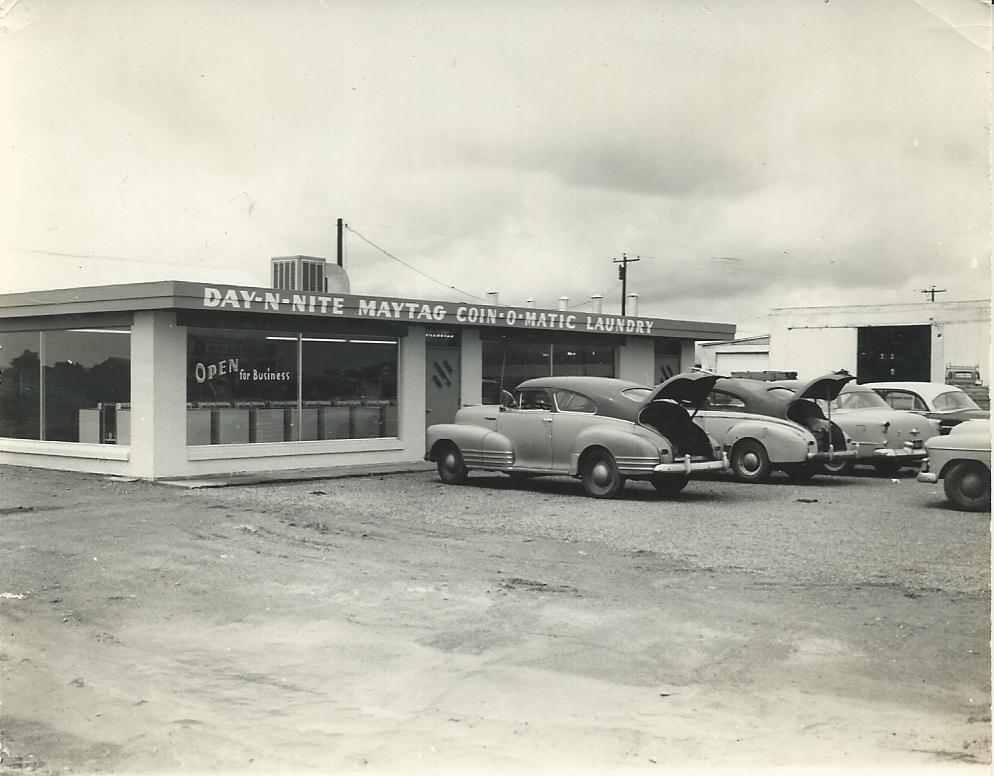
Across Combs Street (the north-south street next to our house) was the Bland Lumber Company. After Dad sold Radio Station KOLJ in about 1961, we continued to operate a business across Combs Street from our home. While we still owned the radio station, my father had bought the corner lot on Combs Street and 11th and started a coin-operated laundry, abotu 1959, I think. The address was 1001 West 11th Street.
In this business I learned the mechanics of washing and drying machines. I helped my dad repair and totally overhaul these machines. After some time, Dad added a coin-operated dry-cleaners. After a while, Dad shut down that business, and leased the building to a barbecue restaurant, while we still lived in Quanah and ran the laundry.
In Google Maps' Street View from May 2011, The Quanah Florist is shown as the business in the laundry building, but I am told that business closed down in 2011. At the time the business located in the former dry cleaning building was Pat's Video, also now closed. In September 2014, the laundry building was empty and there were no signs on the building's windows. There waas a business in the dry cleaning building, with a small sign I cannot recall.
|
|
Besides the laundry business, my two brothers and I also sold the Grit newspaper on a pretty extensive route. I was also the agent in Quanah for the Sunday Oklahoman newspaper.
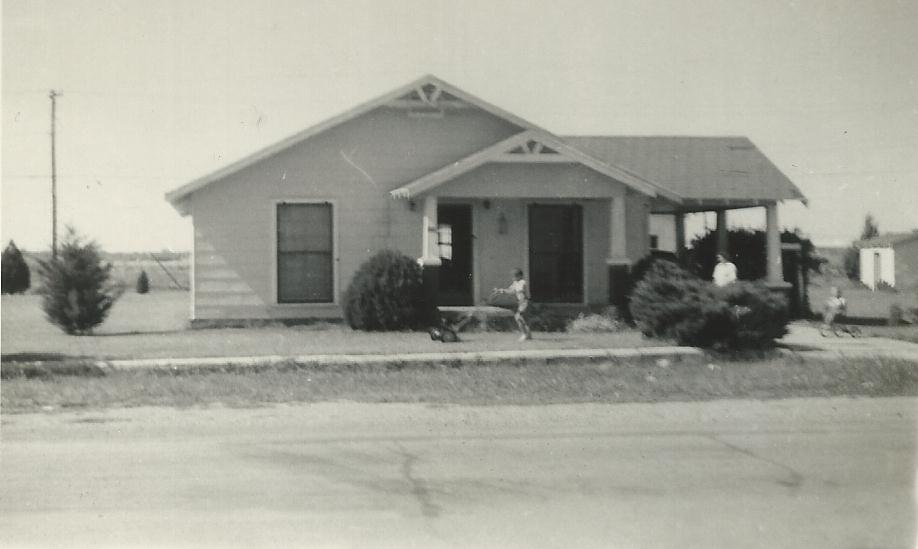 |
Our family also had a hugely productive truck garden. In the summer, we operated a truck stop vegetable stall in front of our house, selling the produce. On the quarter block (1/2 acre) plot, we raised all the vegetables we could eat, can, sell and give away. We also took phone orders and delivered to homes.
We also had a fruit and nut orchard in the yard and garden, the full acre of our plot. We learned a lot about organic gardening, nutrition, and working with the pattern of nature. We continued to operate the "farm" and the laundry business for a couple more years before we moved to an Arkansas farm.
Cattle
Cattle ranching continued to be a major business for Quanah and Hardeman County. Incidentally, it was in Quanah that I started my minor career as a rancher, with one calf I raised as a 4-H Club project. From this I parlayed my modest earnings into a small cattle herd.
|
The basic cattle investment became a major operation for us when we moved to Arkansas in 1963. My dad and I were partners in the cattle business, till I gradually sold off my share to pay for college expenses in the latter 60s.
Name of Honor
I commented that the town of Quanah was named after the Comanche chief Quanah Parker. Quanah Parker's mother was a white woman, from whom he took the name Parker. I have read several books about the chief. In January 2014, for the first time I was able to add Quanah Parker and some members of his family to my family genealogy. I had finally found a connection that I was never aware of before through cousins. I found two of Quanah's sons married members of the Fisher-Asewaynah family.
A Fisher girl married my first cousin Harvey Christian in Oklahoma. I remembered Bernice Christian, and knew she was an Indian, but did not remember which nation. I had recently run down the family connections. One of her ancestors, the father of the two girls who married Quanah's sons, had also been captured by the Comanches. He was a child of a German family who had settled in Texas, named Fischer. Some of them are found in the Comanche rolls with the Fischer name, others with Asewaynah. Rudolph Fischer remained with the tribe and lived as a Comanche.
|
Patti Murphy Obannon commented:
My grandfather John W. Ford worked for my uncle, Marvin Wells. "Daddy John" came to Quanah in 1897 and met Quanah Parker about then. My grandfather Ford talked about sitting and visiting with Quanah Parker.
In 2009, I read a book about Quanah Parker that had a lot of info about his life, and cited letters from his friend Burk Burnett, and others, in his later business and personal associations. (Burkburnett, Texas, near Wichita Falls, is named after Burnett.)
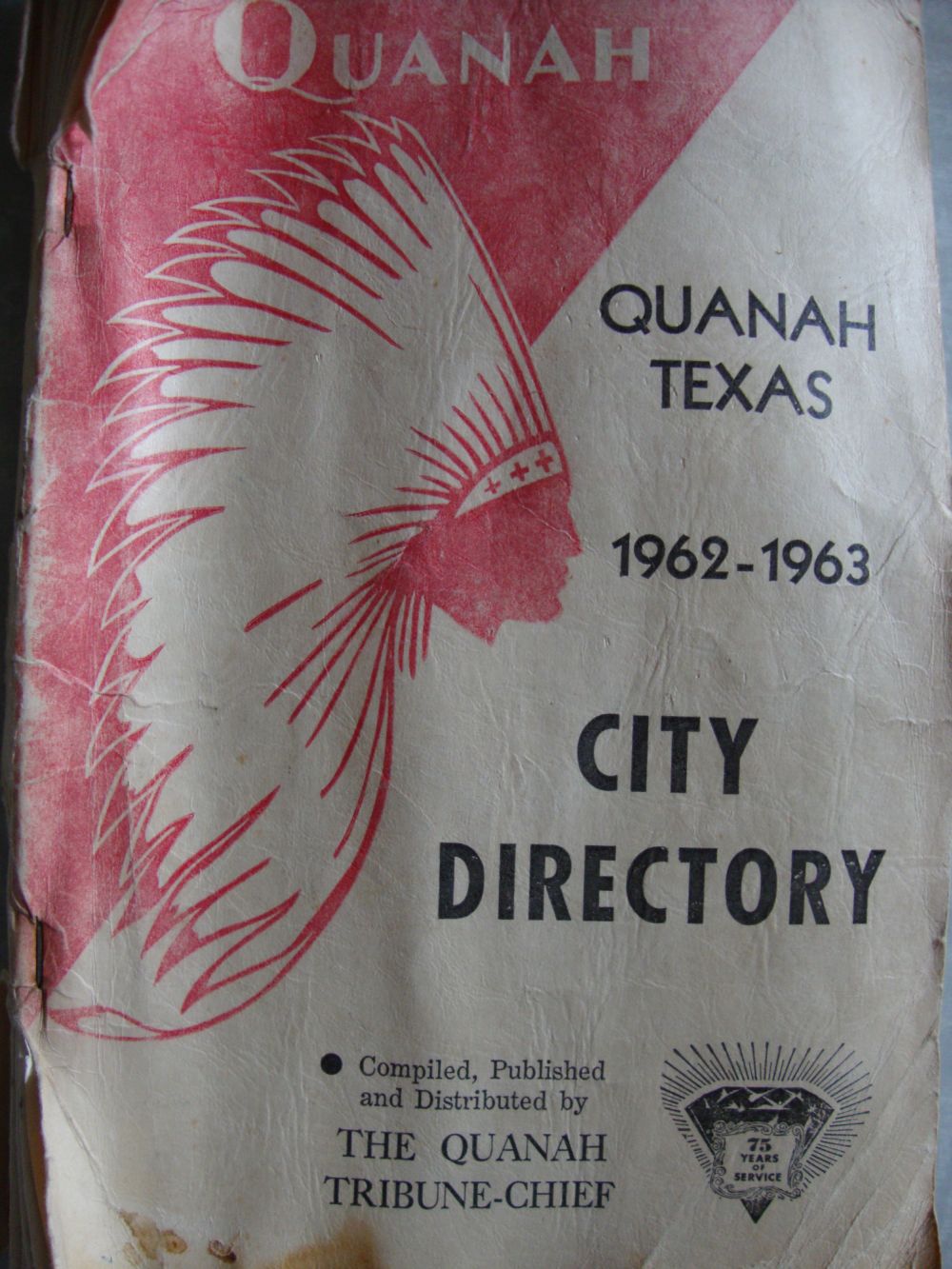
This book is The Last Comanche Chief: The Life and Times of Quanah Parker (Edison, NJ: Castle Books, 2007), by Bill Neeley. Neeley says on p 228 that the town was named in honor of Quanah, Parker, in 1884. In May of 1890, Quanah himself made a statement about this which was quoted in the Quanah Tribune-Chief Newspaper of 23 May 1890 (It would likely have actually been the Quanah Chief, owned by his fellow shareholder, Harry Koch, who founded the Tribune-Chief in 1897.)
The Tribune-Chief
The Tribune-Chief, or its predecessor The Quanah Chief, has been covering news since the founding of Quanah. The paper was founded by Harry Koch (pronounced Kaw), a Dutch immigrant who founded the Quanah Tribune-Chief newspaper and was a founding shareholder of Quanah, Acme and Pacific Railway.
|
Harry established the Quanah Chief newspaper soon after settling in Quanah in 1890, then bought the Quanah Tribune in 1897, merging the two into the famous Quanah Tribune-Chief newspaper, which is still being published. Through his journalism platform, Harry promoted the town and the railway. When we lived there, if I remember right, the owners I knew were Harry's son and his wife. Fred founded Koch Industries, the second-largest privately held company in the United States.
|
Quanah's Speech
Neeley quotes the words of Chief Quanah from the article:
"It is well, you have done a good thing in honor of a man who has tried to do right both to the people of his tribe and to his pale faced friends. May the God of the white man bless the town of Quanah. May the sun shine and the rain fall upon the fields and the granaries be filled. May the lightning and the tempest shun the homes of her people, and may they increase and dwell forever. God bless Quanah. I have spoken."
Neeley says a bit later on: "Quanah frequently visited the town named for him. At times he dressed in his traditional Indian costume, and just as often, he wore a business suit with a stylish hat and diamond breastpin" (p 229).
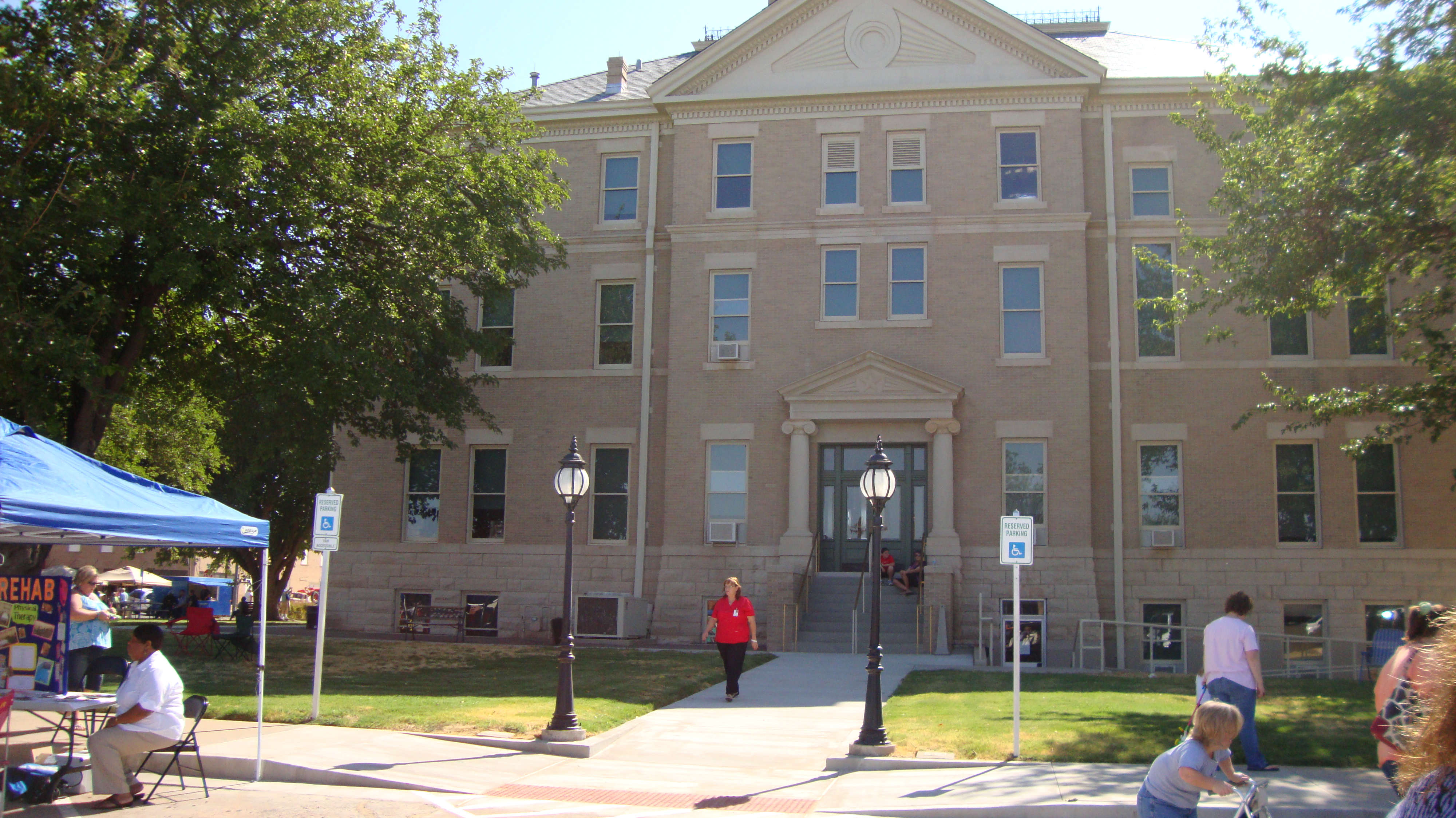
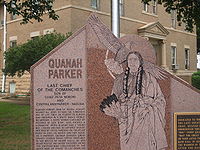
Quanah maintained contacts with his Parker relatives in Texas, and this has continued to this day, with an annual Parker reunion in Quanah, to which Indian and white Parkers come. There is a monument on the court house square commemorating this. I gather from the story and background Neeley provides that the town was named for Quanah because he was actually held in high esteem, even loved by the people of that area.
|
 |
Also related:
![[review]](../graphics/2011reunion.ico) 2011 Quanah Reunion Photos
2011 Quanah Reunion Photos
![[review]](../graphics/facebookbutton.png) My Old Family Photos about Quanah on Facebook
My Old Family Photos about Quanah on Facebook
![[review]](../graphics/bookanimate.gif) Quanah — The Last Comanche Chief
Quanah — The Last Comanche Chief
 Quanah — The Last Comanche Chief - by OBJ on Amazon
 Quanah Parker on the Jenkins Genealogy
*** OBJ Summary Introduction More OBJ Info ***
OBJ's Short Biographical Resume Dr. Obiwan's Computing History
So Many Opportunities in One Lifetime So Many Languages, So Little Time
OBJ Educational Background
Living and Working in Kenya
OBJ Residences and Occupations
"Where Am I From?"
For more on Quanah, Texas, on the Internet:
Acme, Texas History - Texas State Historical Association
Acme Bestwall Gypsum Company
Astronaut Edward Givens, from Quanah – Wikipedia
Dutch's Restaurant, Quanah, Texas
KOLJ – Listen Online
KOLJ Website
Quanah – Hardeman County Historical Museums - Facebook
Quanah, Acme and Pacific Railway - Facebook
QA&P – The Handbook of Texas
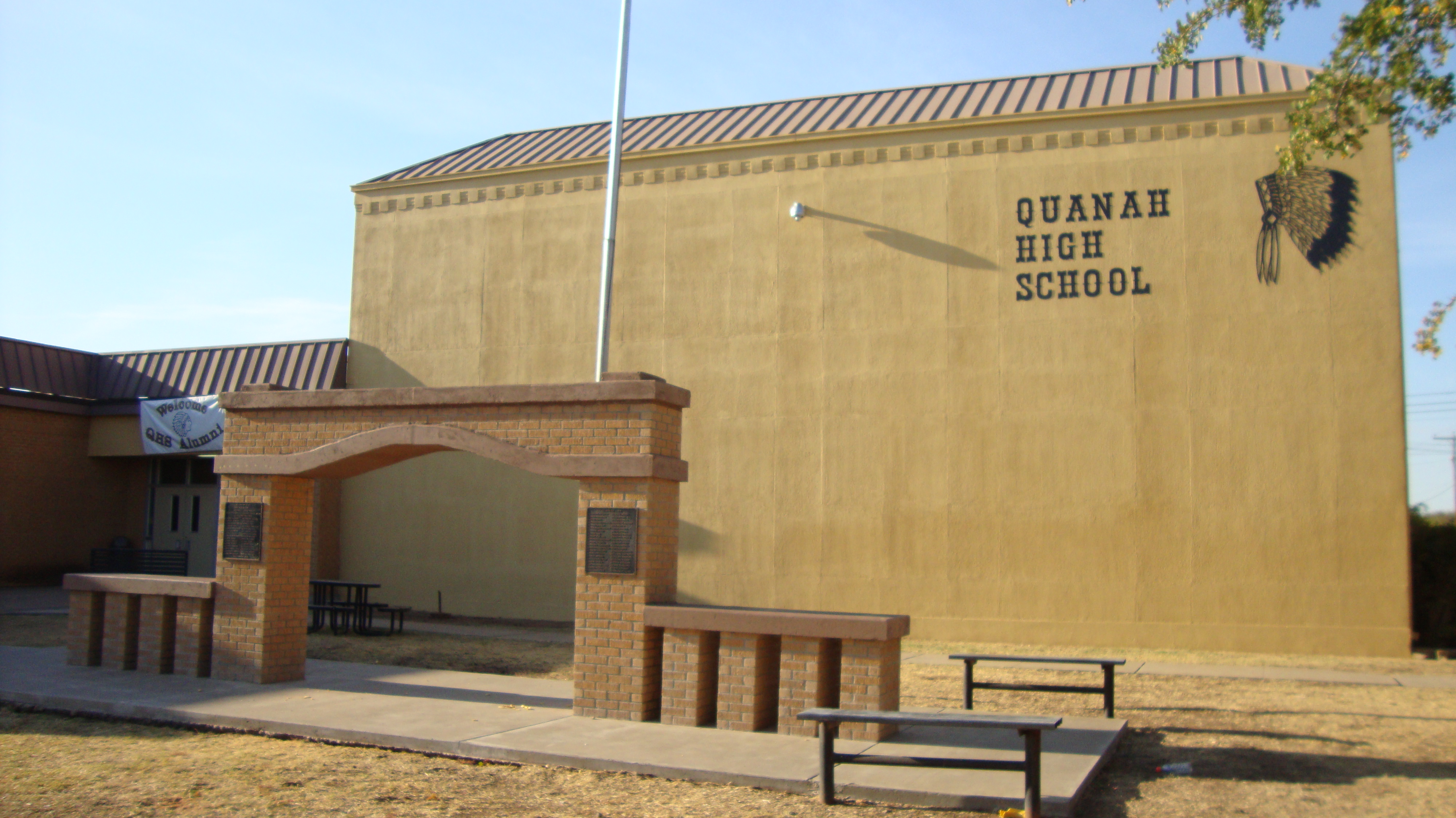
Quanah High School Alumni Association
Quanah - Facebook
Quanah First Baptist Church
Quanah First Baptist Church - Facebook
Quanah High School
Quanah – Wikipedia
Quanah, Texas – Texas Escapes
City of Quanah
Three Rivers Foundation
Traces of the Quanah, Acme & Pacific
US Highway 287
US 287 - map from Ft Worth to Amarillo 6-7 hour drive
For more on Quanah Parker on the Internet:
Blanco Canyon Battle – Wikipedia
Native American Tribes, Photo Gallery - History Channel
Quanah Parker — Comanche Lodge
Quanah Parker — Jenkins Genealogy
Quanah Parker — TexasEscapes
Trail of Tears
OBJ
First posted on Ideas and Interests 13-14 November 2007
Revised September 2008, September 2009 and September 2011
Rewritten 26 December 2013
Revised 3 March 2014
Last updted 12 July 2020
Orville Boyd Jenkins, EdD, PhD
Copyright © 2007, 2009, 2014 Orville Boyd Jenkins
Permission granted for free download and transmission for personal or educational use. Please give credit and link back. Other rights reserved.
filename: objquanah.html